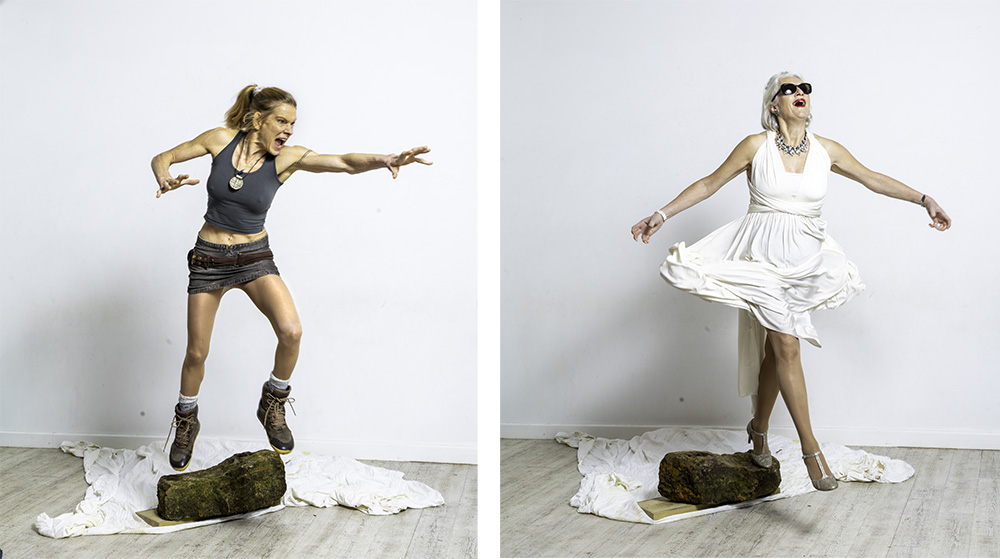
An Interview by Dorset Living about my C I R C U S Exhibition
Updated: 1 day ago
How and when did you first get into photography?
I first caught the photography bug from my maternal Grandfather who used to give us interminable slide shows of his travels whenever we visited. My father was also a keen photographer and let me use his old Canon SLR and a rather leaky Rolleiflex that he once dropped in Aden harbour in the 1940’s and paid a boy to dive down and retrieve it. Back then you could rinse a camera under the tap and it would still work.
When did you develop your signature black and white style?
Well of course there’s no defining moment, a photographer’s style is something that develops over time. When I started my career as a photographer, I was hugely influenced by the likes of John French, Herb Ritts, Peter Lindbergh, and Irving Penn to name but a few. It didn’t seem to me that photography got much better than that. I suppose it was whilst shooting my Show Of Hands collection that my particular style became entrenched.
Why were you drawn to this particular style?
I’m very drawn to simplicity and structure, to removing things from my work rather than adding them. I guess I’m always looking for less, because I often find that in doing so I discover more.
Tell us about C I R C U S – why did you choose this theme for your latest exhibition?
I’ve been orbiting the circus scene for quite some time. My wife teaches silks and acro-balance and we‘ve been attending circus camps and festivals now for many years. It was whilst I was at one of these camps and had just returned from shooting landscapes rather unsuccessfully, that my wife suggested I have a change of scene and shoot circus people. I was instantly hooked.
Where were the images shot?
The images were shot here in Dorset, but also in Devon, Cornwall and Northumberland, Bristol and London. I’ll shoot circus anywhere!
What do you hope people will take away from the photographs?
I hope that the collection will go some way towards changing the general perception of circus that harks back to clowns and lions. People used to ‘run away to join the circus’ as if that was a bad thing, a cop out. But that’s far from the reality, circus requires intense dedication and commitment as well an immense amount of self-discipline and punishing physical exertion. These performers put in hundreds of hours of gruelling training in order to create beautiful and often moving performances. I hope that the collection helps to engender more respect and admiration for the people who go through so much in order to entertain us.
Besides Lighthouse, is the exhibition going anywhere else?
I very much hope so, I would dearly love it to tour (it was in Northumberland for the summer) to cities where circus is rife, such as Bristol and London.
How does it feel when you first see your images displayed in an exhibition space?
Living in a digital age is a mixed blessing. Whilst it’s great that everyone can now see literally millions of images we would never otherwise have seen, we are seeing them through a glass darkly. Looking a photograph of a painting is a far cry from standing in front of it in the flesh, you are merely seeing its poor cousin, and that’s no different for photography. Photographs are meant to be seen printed, there’s no comparison. You need to see their scale and texture to fully appreciate them, to see them glow. It brings me immense pleasure to ‘release them into the wild’ so to speak.
How does living in Dorset inspire you?
Everyone waves the flag for their own country of course, but Dorset is hard to beat. From its varied and ancient coastline to its rolling bocage countryside, it harbours so many special places that never cease to enthral. I’m particularly drawn to the sea which I dip in year round, but I live inland cradled in rolling hills that make me feel intensely connected to nature and immensely privileged.
What’s next?!
More C I R C U S is what’s next. It’s a vast subject and I’ve a lot more images in me I’ve yet to create before I feel I’m done. Then I’ll be producing a book of the work. I tend not to think about what’s next until current project has come to a close. It’s a bit like thinking about your next baby when you’re still cradling your first.